An AI agent needs two parts: a reasoning loop and a set of tools.
The reasoning loop is the agent’s thinking process. It is the continuous cycle of observing what is happening, interpreting the available information, planning what to do next, and acting on that plan.
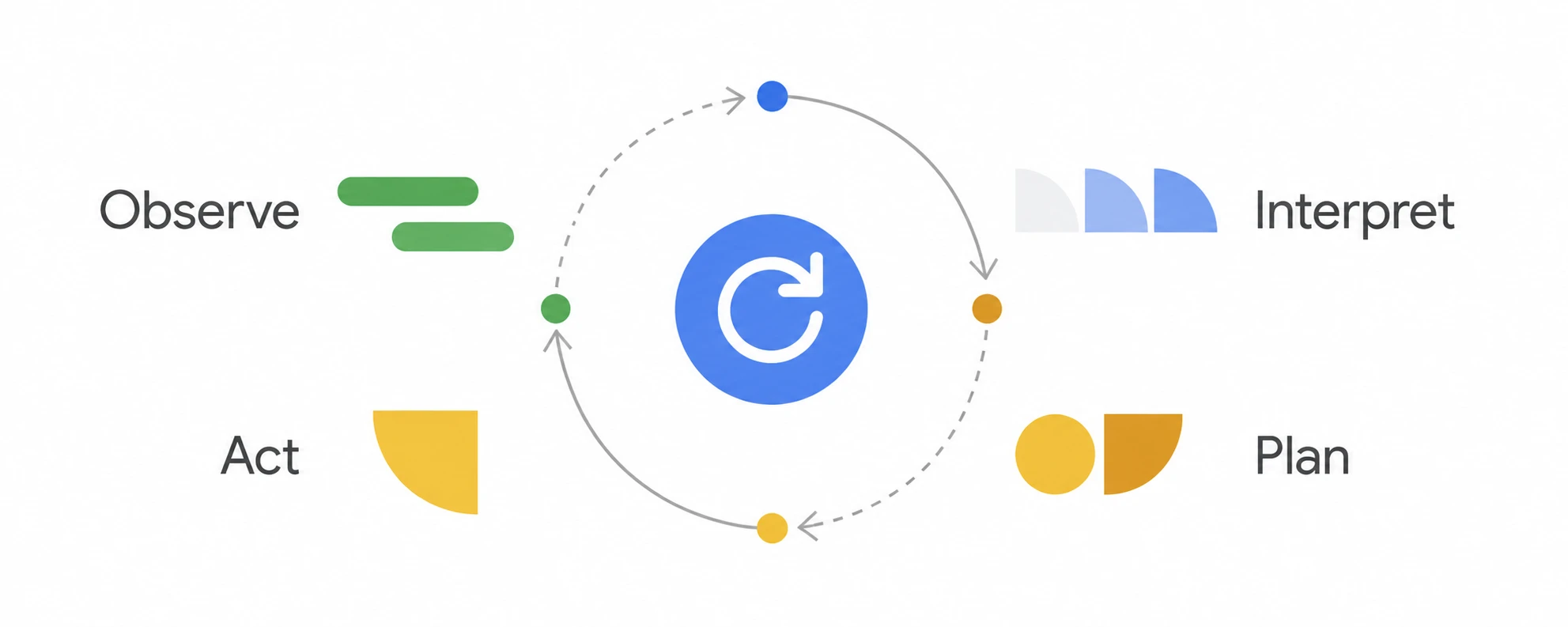
Tools are the functions that let the agent interact with its environment. They can be simple, like reading files or searching the web, or more specialized, like accessing databases, calling APIs, controlling browsers, or operating physical robots.
The combination of reasoning and tool use is what makes agents more interesting than plain language model prompts.
Beyond text generation
Large language models are very good at generating and transforming text, but a prompt usually produces one response. An agent can work through a problem: it gathers information, inspects its environment, calls tools and external systems, updates its plan, and keeps working toward an outcome with less direct human intervention.
What makes an agent
Useful agentic systems tend to have five capabilities:
- Autonomous operation: working toward an objective on its own, over many steps.
- Reasoning and planning: using an advanced model to decide the next action, such as which tool to call.
- Memory and context use: using memory or accumulated context to improve behavior during future work.
- Environmental awareness: observing surroundings through inputs like user requests, API responses, database state, logs, files, and error messages.
- Tool use: interacting with the outside world through available tools. Model Context Protocol (MCP) is becoming a common pattern for exposing those tools.
These capabilities do not need to be equally advanced in every system. A coding agent and a customer support agent can have different levels of autonomy, memory, and tool access. They still follow the same loop: reason about the situation, choose an action, use a tool, observe the result, and continue.
When to use an agent
A prompt gets you one answer, and a script follows fixed steps. An agent plans as it goes and works with the systems involved, so it can carry a task from start to finish in areas like marketing, support, engineering, and operations.
Not every problem needs an agent. Many tasks are better served by a simple prompt, a deterministic script, or a traditional application. An agent is the better fit when a task needs multiple steps, changing context, external systems, and judgment along the way.
Learn more
For a structured introduction, Google has a learning path on agents and its agent ecosystem.