Unix time (often called “the epoch”) is a simple way to represent a point in time: the number of seconds that have elapsed since 1970-01-01 00:00:00 UTC, not counting leap seconds. It’s compact, language-agnostic, and easy to compare and sort.
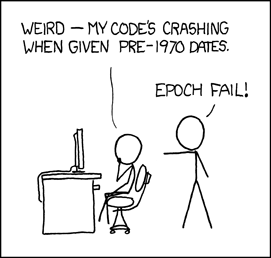
Comic: xkcd #376, used under the Creative Commons Attribution-NonCommercial 2.5 License. Credit: Randall Munroe / xkcd.
TL;DR
- Unix time is seconds elapsed since 1970-01-01 00:00:00 UTC, typically stored as a 64-bit integer.
- Use it for internal storage, comparisons, rate limiting, TTLs, and compact binary formats.
- Don’t use it for display, calendar/timezone logic, or precise elapsed intervals. Use human-readable timestamps (ISO 8601) and monotonic clocks instead.
- Always use 64-bit integers; 32-bit overflows in 2038.
Quick examples
- Shell:
date +%sprints the current Unix time in seconds. - Python:
import time; int(time.time())gives seconds, ortime.time()for fractional seconds. - JavaScript:
Math.floor(Date.now() / 1000), since Date.now() returns milliseconds.
When you should use Unix time
- Machine-to-machine timestamps: compact, fast to compare, and well supported across platforms.
- Databases and indexes where you only need chronological ordering or durations.
- Protocols or binary formats that need a timezone-independent, compact numeric representation.
- Short-lived logging or metrics where space and parsing speed matter.
Practical rule: use Unix time for internal storage and calculations (sorting, rate limiting, TTLs), especially when you also store the timezone or a canonical representation elsewhere.
When you shouldn’t use Unix time
- For displaying dates to humans, because it isn’t readable and depends on timezone conversion.
- For legal/audit records where a human-readable, unambiguous timestamp (ISO 8601 / RFC 3339) is expected.
- When you need to express calendar concepts (local midnight, business days, recurring events). Those require civil/calendar-aware libraries.
- For measuring precise elapsed intervals when the system clock can change. Use a monotonic clock instead (e.g.,
clock_gettime(CLOCK_MONOTONIC)/time.monotonic()in Python).
Gotchas and tips
- Leap seconds: Unix time typically ignores them. If you need to account for leap seconds explicitly, Unix time may be the wrong primitive.
- Year 2038: 32-bit signed integers overflow for second-based Unix time. Use 64-bit integers for long-term storage.
- Precision: if you need sub-second precision, store fractional seconds (floats) or separate nanosecond fields.
- Always record timezone or store an ISO 8601 string when you also care about how that instant was presented to a user.
Recommended pattern
- For logs and APIs: prefer ISO 8601 / RFC 3339 formatted timestamps (e.g.,
2025-10-16T12:00:00Z) for human readability and interoperability. - For internal calculations and compact storage: keep a Unix epoch in seconds or milliseconds, and make the unit (seconds, ms, or ns) part of a clear contract. Use 64-bit integers so the values don’t overflow in 2038.
- For durations or elapsed time: use monotonic clocks rather than wall-clock Unix time.
Happy timestamping!